Article
Resistance Bands for Women: Can You Build Real Strength at Home?
By Samantha Hobley · Last updated 18 June 2026
Resistance bands for women: can you build real strength at home? Perth coach Samantha Hobley explains what resistance bands do and how to start at home.
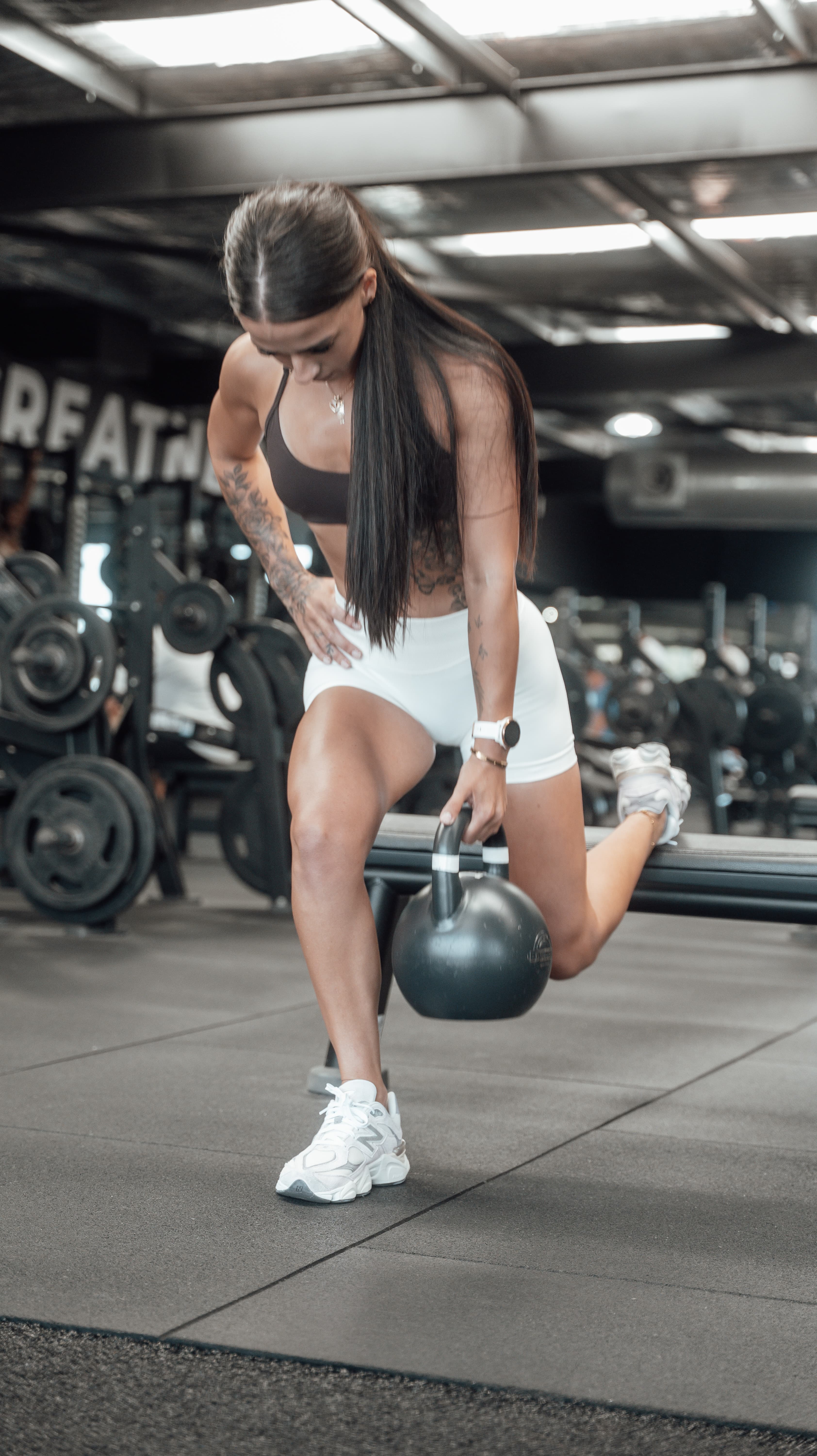
Can you build real strength with resistance bands at home? Yes, you can. I see it with the women I coach. Your muscles do not know whether the resistance is coming from a dumbbell, a machine, or a length of stretchy rubber. They only know they are being made to work. Bands make them work.
If part of you doubts that a stretchy band can really build strength, that is a fair thing to wonder. So here is a straight answer from someone who works with this every day. I am Samantha Hobley, a personal trainer in Perth. I hold a Certificate IV in Fitness, and I have spent the better part of ten years helping women get stronger. On this page I will give you the honest version of resistance bands, not the version written to sell you more of them. Bands are one of the best places to start. They are not where you finish. I will show you both.
What resistance bands actually do for your body
Your muscles get stronger when you ask them to do a little more than they are used to. That is the whole game. Work them hard enough that the last couple of repetitions feel genuinely difficult, do that regularly, and your muscles adapt by getting stronger. Trainers call this progressive overload. All it means is this: make it a bit harder over time.
A band creates that challenge with tension instead of weight. The further you stretch it, the harder it pushes back. Stretch a heavier band, or stretch the same band a little further, and you have made the work harder. That is progressive overload, no dumbbells required.
The research backs this up. A 2019 review published in the journal SAGE Open Medicine compared training with bands against training with weights and machines, and found bands produced similar gains in strength. Your body responds to the effort, not to the equipment.
This matters more as we get older. Australia's physical activity guidelines, the ones healthdirect publishes, recommend that adults do muscle-strengthening activity on at least two days every week. Resistance bands are one of the simplest ways to actually do that, at home, without a gym membership or a room full of gear.
And if walking into a gym feels like a lot right now, that is exactly why bands suit so many women. You can start in your own lounge room, in private, with no one watching and no equipment you have to figure out. No feeling lost. Just you, a band, and a few simple movements you will pick up in minutes.
The myth that bands are "just for toning"
You have probably seen bands sold next to the light pink dumbbells, filed under "toning" as though that is a separate, gentler thing women do instead of real training. It is not. "Toning" just means having enough muscle to see some shape, with low enough body fat to see it. You get there by building muscle and losing fat. There is no special women's version of strength that lives in a separate aisle.
The worry on the other side is just as common: will bands make me bulky? No. Building large, bulky muscle takes years of heavy, dedicated training, plus a level of the hormone testosterone that women do not have in the same amount as men. What bands will give you instead is shape, a stronger back, firmer glutes, better posture, and the kind of everyday strength that makes lifting things you used to ask for help with feel easy. Not bulk. Capability. For the deeper read on the bulky and toning myth, see how women actually build lean muscle.
Which resistance bands to buy in Australia
You do not need anything fancy, and bands are one of the cheapest pieces of fitness gear you can buy. There are three types worth knowing, in plain terms:
- Long loop bands. Big continuous loops of rubber. These are the most useful all-rounder and the best first purchase. You can use them for nearly every exercise in this article.
- Tube bands with handles. A rubber tube with a handle on each end. The handles are comfortable for arm and shoulder work.
- Mini bands. Small loops you place around your legs, sometimes called glute bands. Brilliant for the glutes and hips.
For most women starting out, buy a set of long loop bands in three strengths (a light, a medium and a heavy), plus a set of mini bands. That covers almost everything you will want to do. Bands are usually labelled by how much tension they give, often shown as a kilogram range like 7kg to 15kg, so a small set gives you easy and harder options in one purchase.
You will find them in Australia at sporting stores such as Rebel Sport and Decathlon, and at department stores such as Kmart and Big W. A basic set from any of these will do the job. You do not need the expensive ones to get started.
A simple full-body band routine to start
Here is a beginner routine you can do at home. It works your whole body in about twenty to thirty minutes. Do it two to three times a week, with a rest day in between where you can.
For each exercise, do 2 to 3 sets of 10 to 12 repetitions. Pick a band where the last couple of repetitions feel hard but you can still keep good form. Move slowly and with control, especially on the way back. If you are brand new to exercise, returning after a long break, or working around an injury or health condition, it is worth getting checked by your GP or a trainer before you start.
- Banded squat (legs and glutes). Stand on the middle of a loop band, feet shoulder-width apart, and hold the top of the band up at your shoulders. Sit back and down as though lowering into a chair, then stand back up. Keep your chest up and your weight in your heels.
- Banded row (upper back). Sit on the floor with your legs out in front, loop the band around your feet, and hold an end in each hand. Sitting tall, pull your hands back towards your ribs, squeezing your shoulder blades together, then slowly straighten your arms.
- Banded chest press (chest, shoulders, arms). Wrap a band across your upper back and hold an end in each hand at chest height. Press your hands forward until your arms are straight, then bring them back with control.
- Banded glute bridge (glutes). Lie on your back, knees bent, feet flat, with a mini band looped just above your knees. Push your hips up towards the ceiling, squeezing your glutes and gently pressing your knees out against the band, then lower down.
- Banded overhead press (shoulders). Stand on the middle of a band, feet hip-width apart, holding an end in each hand at shoulder height. Press your hands straight up overhead, then lower them back to your shoulders.
- Band pull-apart (upper back and posture). Hold a band out in front of you at chest height with both hands, arms straight. Pull your hands apart until the band touches your chest, squeezing your shoulder blades, then return slowly. This one is a quiet hero for posture.
To make any of these harder over time, move to a heavier band, or slow the movement down so your muscles spend longer under tension. That is how you keep getting stronger. The lightest band that leaves you working hard this week will often start to feel easy within a few weeks. That is not in your head. It is your muscles adapting, and it is your signal to reach for the next band up.
Bands for sore joints and for starting later in life
If it has been a while since you trained, strength training is one of the most useful things you can do for your body, and bands are a gentle place to begin. As we get older, we naturally start to lose muscle and bone more quickly than before. Strength work slows that down and helps protect against falls and fractures later in life. healthdirect notes that strength training improves bone density and takes pressure off the joints, which can mean less pain from conditions like arthritis.
Bands are also kind to sore joints, and here is why. A band is at its easiest at the very start of a movement, where a joint is most vulnerable, and gets harder as you move into the stronger part of the range. A heavy dumbbell does the opposite: it loads the joint hardest right where it is weakest. So if your knees, shoulders or back are not what they used to be, bands let you build strength without the heavy pounding.
The payoff is bigger than protection. It is lifting a suitcase into the overhead locker without a second thought, walking up a hill without your knees aching, and feeling like your body is your own again.
When bands stop being enough (and what to do next)
Here is the part the shops selling bands will never tell you. Bands are a brilliant start. They are not the finish line.
There is a ceiling. Even a heavy band only pushes back so hard. Once your strongest band stops feeling difficult, your muscles are no longer being challenged, which means they stop getting stronger. Most women who train consistently reach that point within a few months. That is not a failure. It is proof you have got stronger, and it is exactly when free weights earn their place.
Dumbbells and barbells let you keep adding small amounts of weight, far beyond what any band can offer, so you can keep getting stronger for years. Weights are also easier to measure. A band makes it hard to know exactly how much you are working against, while a 7kg dumbbell is always a 7kg dumbbell, which makes your progress simple to track.
So the honest path looks like this. Start with bands at home. Build the habit and the basic strength. Then move to weights once bands stop feeling hard. You can do that at home with a set of dumbbells, or in a gym where heavier weights and someone to guide your technique are on hand. When the women I coach are ready for that step, I train them in person at Doherty's Gym in Perth, and online right across Australia. If you want to see how that works, you can explore the coaching options here.
Common mistakes to avoid
- Using a band that is too light. If it never feels hard, your muscles have no reason to change. The last couple of repetitions should be a real effort.
- Rushing the movement. Fast and sloppy does very little. Slow and controlled does the work.
- Letting the band snap back. Control it on the way back, not just the way out. That lowering half is where a lot of the strength is built.
- Never making it harder. Once an exercise feels easy, use a heavier band or slow it down. Staying comfortable means staying the same.
- Skipping your lower body. Your legs and glutes are your biggest muscles and give you the biggest return. Do not let bands become an arms-only habit.
Frequently Asked Questions
Yes. Muscles grow stronger in response to tension and effort, and bands supply both. As long as you work hard enough that the last few repetitions feel difficult, and you gradually make it harder over time, bands build real muscle and strength. They are especially effective for beginners and for anyone training at home.
For building strength, they are very close. A 2019 review in SAGE Open Medicine found band training produced similar strength gains to weights and machines. The main difference shows up later: bands have a ceiling, while weights let you keep adding load for years. Bands are an excellent start, and weights are the natural next step.
Start with a set of long loop bands in three strengths (light, medium and heavy), plus a set of mini bands for your glutes. That combination covers nearly every exercise you will want to do. You can find affordable sets at Rebel Sport, Decathlon, Kmart or Big W. There is no need for the expensive options when you are starting out.
Two to three times a week is plenty to build strength, with a rest day in between where you can. Australia's physical activity guidelines recommend muscle-strengthening activity on at least two days a week, so a couple of full-body band sessions ticks that box and leaves room for walking or other movement on other days.
They help. Building muscle with bands supports fat loss because muscle is active tissue that uses energy, and strength training protects your muscle while you lose weight. Bands are not a magic fix on their own. Lasting results come from strength work paired with sensible eating. Our calorie calculator is a good place to start on the eating side, and our guide on whether a personal trainer is worth it for weight loss is a useful next read.